From memory to a clearer record
When a symptom comes and goes, the details can become difficult to recall. Was it the same area as last time? Did it begin during the activity or afterwards? What was it stopping you from doing?
A short written record or visual body map can give you something more specific to refer to when discussing a concern. It does not need to be a perfect account of every sensation. The aim is to organise useful observations, not to diagnose yourself.
NHS Fife describes body charts and pain diaries as tools that can support preparation for a healthcare appointment. That is a practical use of recording, rather than proof that tracking will improve every person's symptoms or treatment outcome. 1
What is a body pain map?
A body pain map is a picture of the body on which you indicate where symptoms are felt. It might be a printed outline, a drawing or an interactive digital map with selectable regions.
Front and back views can help you distinguish, for example, discomfort at the front of a knee from discomfort behind it. Recording the side also matters: “left shoulder” is more precise than “shoulder pain”.
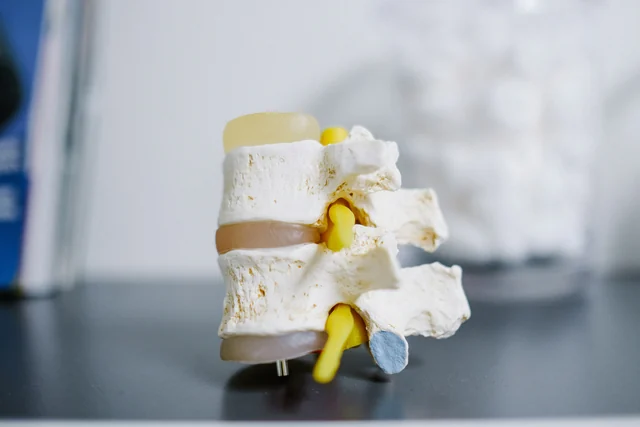
The mark describes a location, not a diagnosis. Selecting the knee does not establish whether a tendon, joint or another structure is involved. Similarly, a lower-back marker cannot identify a particular disc as the cause of pain.
A map works best alongside a description of what you notice and how it affects you. It is a starting point for a discussion, not a substitute for the questions and examination that may be needed. 1
What information is worth recording?
A useful entry gives enough context to understand the concern without becoming a lengthy report. These are general recording suggestions; they are not a list of fields available in every app.
Location and sensation
Record the area and side, and whether the sensation stays in one place or seems to spread. Use ordinary words such as aching, sharp, tight or tingling rather than trying to name an injury.
If you describe weakness, add what you mean: for example, difficulty performing a task, a feeling of instability or a change in strength. Those experiences are not necessarily interchangeable, and a label on a map cannot distinguish them.
Timing and change
Note when you first noticed the problem, whether it is constant or intermittent, and whether it has happened before. Include the date and approximate time of an entry. If you are unsure when something began, say so rather than inventing an exact date. 3
Activity and everyday impact
Describe what was happening before, during or after the symptoms. Useful detail might include a run, prolonged sitting, lifting or a change in usual activity. Also note what became difficult: climbing stairs, walking, sleeping, working or completing a session.
NHS Fife's diary includes activity, pain ratings, medication and general comments about sleep or feelings. These are examples of context a clinician may find useful, not instructions to change medication in response to your own diary. 2
Previous concerns and what you tried
Include a relevant previous injury, whether it was assessed, and any advice you were given. Distinguish a confirmed diagnosis from your own suspicion. Briefly record adjustments or treatments you tried and what you noticed afterwards.
A symptom rating can be useful if you use it consistently, but it is only part of the record. Describe function too. A number alone does not identify a diagnosis, explain why pain changed or establish that an activity is safe. 3
Match the record to the tool
An app may offer categories and structured questions rather than a free-text diary. Use the fields it actually provides. Keep a separate note for relevant information that does not fit, rather than assuming the app captures it automatically.
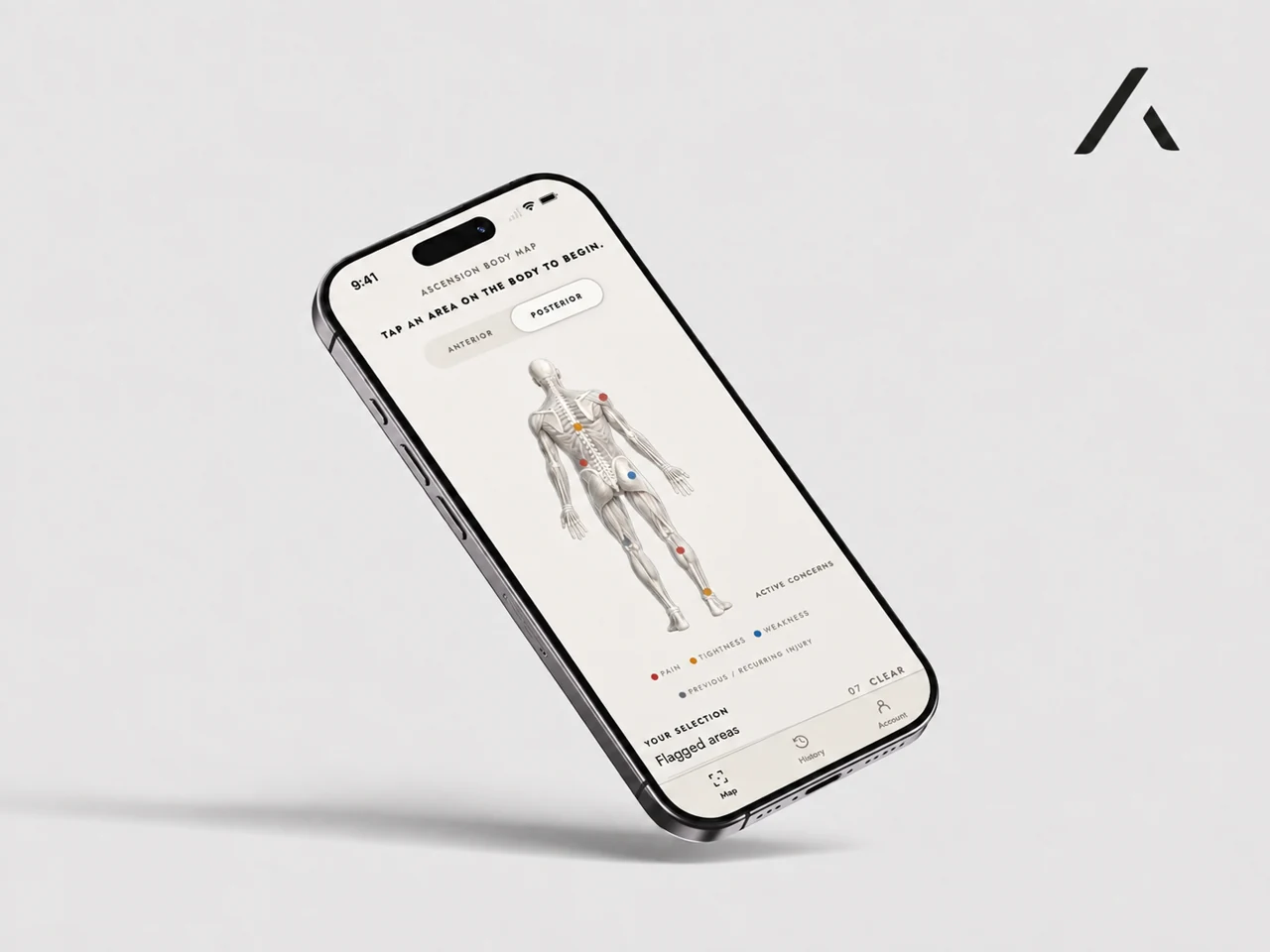
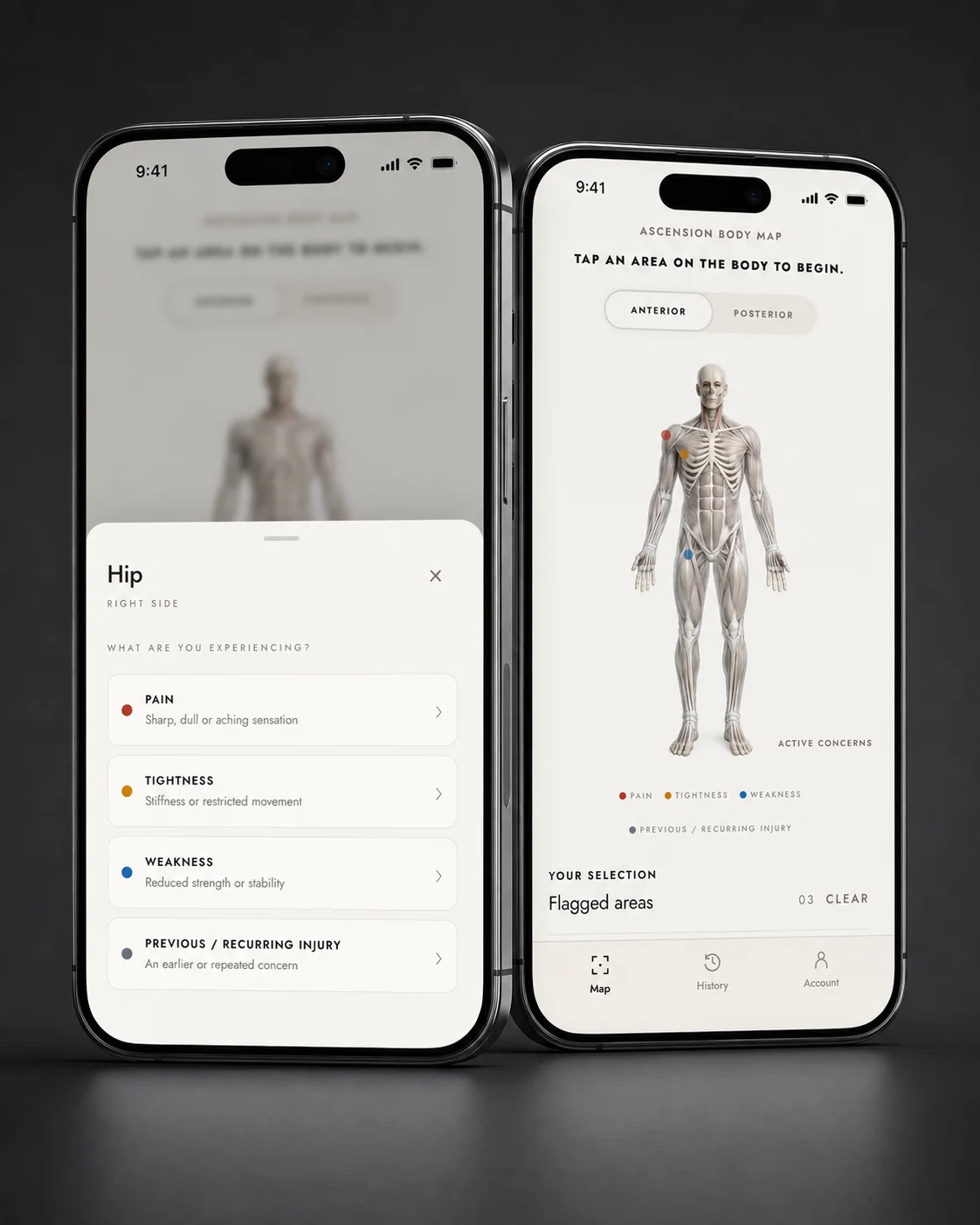
In Ascension Body Map, the initial map lets you identify an anatomical region, its side and a symptom category. The four categories are Pain, Tightness, Weakness and Previous / recurring injury. These are ways to describe a concern, not diagnostic findings.
Why symptom history can be useful
Dated observations can make it easier to explain the order of events. “I noticed this after two recent runs, but not after walking” gives a different starting point from “it happens sometimes”.
For recurring Achilles discomfort, a record might distinguish symptoms during a run, later that day and the following morning. For knee symptoms, it might show whether stairs, sitting or a particular exercise felt difficult on different occasions.
These observations can inform questions for an assessment. They do not prove that running, stairs or any other activity caused an injury. Several things may have changed at once, and a quiet day does not establish that a condition has resolved.
MS-UK's pain diary is intended to help people describe their experience before and during appointments. It was developed in the context of multiple sclerosis; its communication prompts are useful examples, not evidence that a particular app improves outcomes for every physical complaint. 3
Keep the record manageable. NHS Fife notes that a diary need not be completed every day and can be useful for a short period when circumstances change. If you are already receiving care, ask what information would be most useful to bring to your next appointment. 2
How to use a body map in practice
Start with the observation you can make reliably. Locate the area, describe the sensation and add the context you remember. You do not have to work out the diagnosis first.
From a vague recollection to a clearer record
“I keep getting pain around my ankle after running” leaves several questions unanswered. The fictional example below shows how a brief note can make the account more specific.
This account gives a clinician details to explore. It does not confirm Achilles tendinopathy, prove that the run caused damage or tell the person whether to continue running.
Using the ABM map controls
- Choose the front or back view. For the example above, the posterior view shows the Achilles regions.
- Select the relevant region and side. Check the label before proceeding; “left” and “right” refer to your body.
- Choose the category that best describes the concern. In this example, Pain describes the ache without claiming a diagnosis.
- Review the flagged areas. The map provides edit and remove controls, and asks you to choose one primary region before continuing.
The example's dates, running duration and free-text observations illustrate a general symptom record. They should not be read as a promise that every detail has a matching ABM field. Follow the app's actual questions, and keep any additional context separately if necessary.
When tracking is not enough
A record is not a diagnosis, an emergency assessment or proof that it is safe to continue an activity. Do not delay getting help while you wait to collect more entries or look for a pattern.
Arrange a clinical assessment if symptoms keep returning, persist, change or interfere with daily activities or exercise. New severe, rapidly worsening or otherwise concerning symptoms need prompt medical advice. If you need medical help now, contact your GP urgently or use the relevant urgent-care service. In England, NHS 111 can help direct you to appropriate care. 4
Do not assume that saving an entry sends it to a clinician or means someone is monitoring it. If you want professional advice, contact an appropriate healthcare service directly.
Introducing Ascension Body Map
Ascension Body Map is a separate digital product for organising physical concerns and accessing educational, non-diagnostic guidance. It is not the Ascension Movement Screen or the Ascension Assessment Protocol, and using it is not a practitioner-led clinical assessment. 8
The product is intended for adults aged 18 and over who are currently in the UK and can answer questions about their own concern. The map includes anterior and posterior views, selectable body regions and the four symptom categories described above. More than one region can be flagged, with one primary region selected to continue. 7, 8
The app also provides a History area with links to completed guidance. It identifies Body History and Check-Ins as full-access features. Check the current access options rather than assuming that every history feature is included for every user. 7
The AST product page explains the wider question-and-guidance process. Its guidance does not identify underlying pathology or replace an individual assessment. A map marker, a category or a guidance result should not be treated as a confirmed diagnosis.
A clearer account of what you are noticing
A useful symptom record connects location with context: what you felt, when you noticed it and what changed in everyday life. It can be simple, and it can be kept on paper or in a suitable digital tool.
The purpose is to make your observations easier to explain, while recognising when professional help is needed. A record supports that conversation; it does not make the clinical decisions for you.
If a visual approach suits you, explore how Ascension Body Map works and review its current features and access options.